


Directed by Laura Ulloa, BfNA explores and designs for the reciprocal dynamics between environments, cognition and collective adaptation.
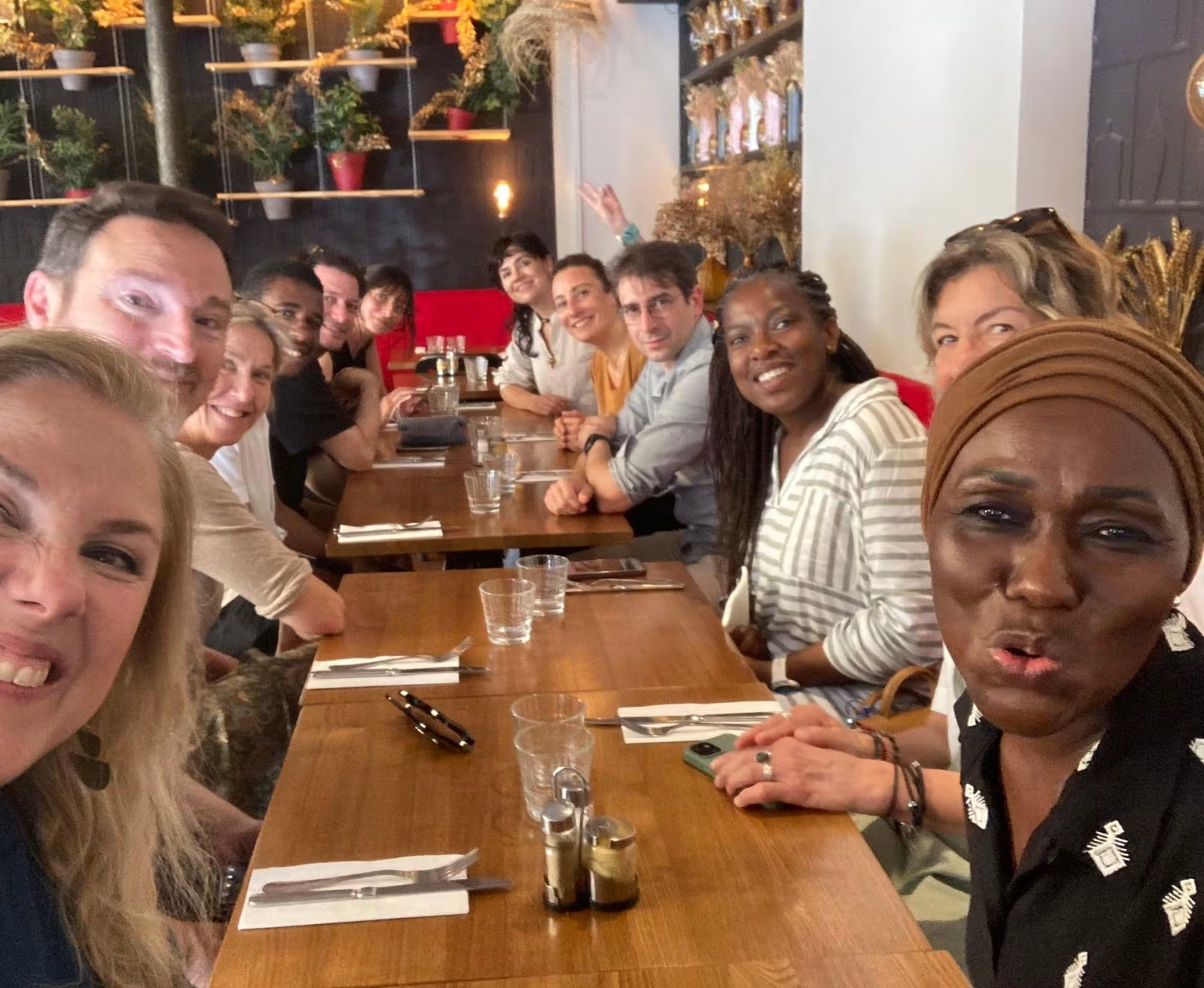

Ana-Nour
Social Impact / Neural Architecture
West Africa / International
International
Association Ana-Nour / BfNA
Ongoing Collaboration
Ongoing Collaboration / Neuroeducational Environments / West Africa
[Summary]
Neuroeducational environments / attention, movement, thermal stress, light and dignity in learning spaces across underserved contexts.
[Team]
Association Ana-Nour
[Temporal Arc]
Immediate (attention/comfort) · School day (learning readiness) · Long-term (educational resilience)
[Direction of Effect]
ACTIVATE (learning/attention) · REGULATE (stress/comfort) · SUPPORT (social learning + dignity)
[Neural Tags]
L1 = Daylight optimisation · S1 = Social contact activation · B1 = Restorative environment · B3 = Biophilic/material volume
[Biological System]
Attention · Memory · Stress regulation · Social learning · Cognitive development
[Description]
Research into learning environments shaped through cognition, movement, environmental behaviour and adaptive educational ecologies.The project investigates how educational environments influence attention, memory, stress regulation, movement and collective learning behaviours. Bridging architecture, neural science and environmental psychology, the research develops adaptive educational frameworks integrating sensory conditions, spatial organisation, materiality and behavioural observation to support cognitive development and social adaptive functioning.Ongoing Collaboration / Ana-Nour connects neuroeducation, school environments and West African social equity, treating classrooms as environmental regulators of attention, heat stress, sound, light and developmental dignity.
[Key Figures]
Typology: Social Impact / Neural Architecture · Neuroeducation · West Africa · learning environments · environmental dignity · Association Ana-Nour
[Neural Analysis]
NEUROEDUCATION EQUITY: Learning spaces are evaluated through attention, heat stress, acoustics and brain development, making environmental quality a matter of educational justice.
NEUROEDUCATIONAL EQUITY [L1][A3][T1][S1]: School environments in under-resourced contexts must be analysed as neural infrastructure: heat, CO2, noise, glare, crowding and material poverty all compete with attention, memory and teacher-student synchrony. Barrett et al. (2015) supports the design-learning link; Allen et al. (2016) supports air/CO2 effects on cognitive performance; noise reviews support the classroom-acoustics claim. BfNA frames Ana-Nour not as charity, but as environmental justice: the nervous system should not pay the price of bad rooms.
[Social Impact]
SOCIAL: The initiative links school infrastructure with neuroeducation in underserved contexts across West Africa.
[ROI Sustainability]
ROI: Low-cost environmental improvements can create educational value through attention, attendance, reduced fatigue and better teacher-student conditions; claims should be measured before being commercialised.
IMPACT: Better learning environments support attention, attendance, adaptive functioning and long-term educational resilience, particularly in under-resourced contexts.
[Applied R&D Lens]
Measure classroom heat, CO2, light and sound against attention, fatigue and teacher-reported learning quality.
Citations:
Peter Barrett et al. (2015), Building and Environment, DOI: 10.1016/j.buildenv.2015.02.013, https://www.sciencedirect.com/science/article/pii/S0360132315000700 · J.G. Allen et al. (2016), Environmental Health Perspectives, DOI: 10.1289/ehp.1510037, https://pubmed.ncbi.nlm.nih.gov/26502459/ · Maria Klatte et al. (2013), Frontiers in Psychology, https://pmc.ncbi.nlm.nih.gov/articles/PMC3757288/ · Association Ana-Nour / BfNA internal collaboration context.
Copyright:
Project Credits: Association Ana-Nour / BfNA; Team: Association Ana-Nour .Laura Role: Laura Ulloa / BfNA - ongoing collaboration, neural architecture framing and research development.Image Credits: © Association Ana-Nour / BfNA / Laura Ulloa / BfNA. All research text and conceptual framing reserved.Source: source to be confirmed.Project Credits & Copyright Notice: Every effort has been made to identify and acknowledge architects, consultants, collaborators, photographers, visualisation studios and other contributors associated with each project. Project descriptions have been rewritten and curated by Bureau for Neural Architecture (BfNA). Architectural works, photographs, renderings, drawings, trademarks and visual material remain the property of their respective authors, studios, photographers, visualisation teams and rights holders. Contributors are credited wherever information is available. Rights remain with their respective authors and rights holders.
© 2026 Bureau for Neural Architecture. Developed by Cavolo Studio.
Privacy Policy & Legal Notice
